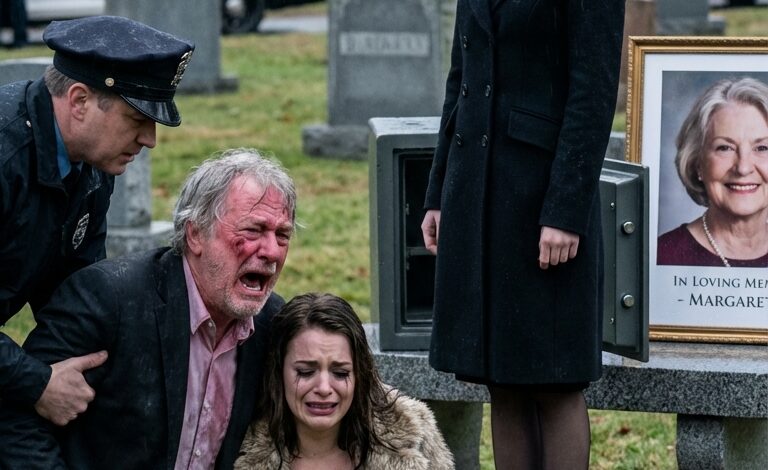
If you have ever been taught that silence is just another word for surrender, or that a gentle woman is destined to fade into the beige wallpaper of history, then you have never met my mother.
My name is Lena Hartwell, and my mother spent her entire life proving that the loudest person in the room is rarely the one holding the detonator.
She never fought fire with fire.
She fought it with a rising tide—slow, quiet, patient—until the people who underestimated her found themselves standing knee-deep in consequences they never saw coming.
Three days ago, I stood inside the velvet hush of Fairmont Memorial Chapel.
The air was thick with lilies and expensive hypocrisy.
Two hundred people in tailored black whispered condolences they didn’t mean, their voices floating beneath stained glass that turned grief into something decorative. At the center of it all sat my mother’s ivory casket—polished so perfectly it reflected the chandelier like a mirror.
To them, Margaret Hartwell was a tragedy.
To my father, Gregory Hartwell, she was an inconvenience finally resolved.
He wasn’t there.
He was in Cancun—according to his assistant—“unreachable due to travel delays.”
Translation: he was on a white sand beach with his mistress, celebrating a freedom he believed he had won simply by waiting long enough for illness to do what divorce never could.
The priest had just begun the final commendation when my phone vibrated.
A single message.
From my mother’s number.
Section C. Plot 19. Come alone. Now.
For a moment, the world tilted.
My mother had been dead for twelve hours.
Before I tell you what waited in that graveyard, you have to understand the architecture of the silence that built toward it.
The hospital room where she spent her final days smelled of antiseptic and surrender.
Machines hummed softly, counting down time in indifferent beeps.
My father stood against the far wall, scrolling through his phone, the fluorescent light glinting off his Rolex.
Every few minutes, he checked the time.
He treated death like a delayed business meeting.
When he finally announced he had to leave—something about a “critical merger in Tokyo”—my mother and I didn’t correct him.
We both knew the truth.
There was no merger.
Only Celeste Monroe.
Thirty-six. Blonde. Impeccably dressed.
Listed on paper as a “consultant.”
In reality, she had been strategically threaded through my father’s finances—and his life—for six years.
When the door clicked shut behind him, my mother’s hand tightened around mine.
Her eyes cleared in a way that made my stomach drop.
The pain didn’t vanish—but something sharper took its place.
“Cruelty is loud, Lena,” she whispered.
“Justice is quiet.”
She pressed something into my palm.
A key.
Heavy. Antique. Cold as truth.
“He thinks silence means I wasn’t fighting,” she said. “But I’ve been fighting for years.”
She told me a woman named Miriam Vale would come.
I was to let her in.
Sign whatever she placed in front of me.
No hesitation.
“The roses,” she added, her voice thinning. “When they bloom, the truth blooms too.”
That night, my mother died.
Continue reading on the next page…