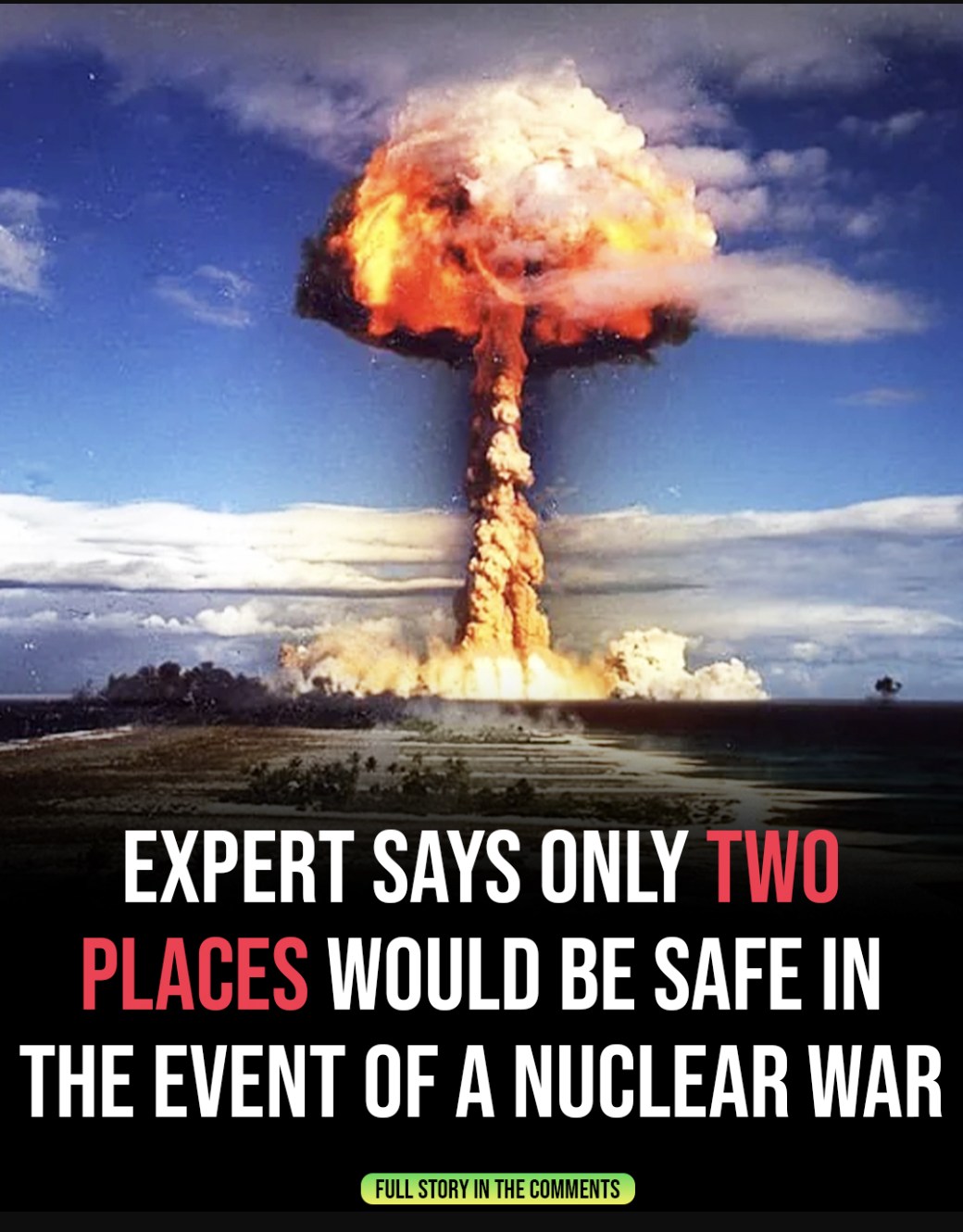
As geopolitical tensions increase following reported U.S. and Israeli airstrikes on Iran, many Americans are revisiting a difficult question: in the event of a large-scale military escalation — even a potential World War III scenario — which U.S. states would statistically offer the lowest nuclear risk exposure?
While defense analysts emphasize that no location is completely risk-free in a full-scale nuclear conflict, national security experts say geography and proximity to strategic military infrastructure would play a critical role in survival outcomes.
Rising Global Security Concerns
Recent developments in the Middle East have heightened global security discussions. Former U.S. President Donald Trump and senior officials have accused Iran of advancing its nuclear capabilities. However, reporting from The New York Times indicates that several of those claims remain disputed or unproven.
The reported joint military operation — referred to as Operation Epic Fury — allegedly targeted key cities including Tehran, Isfahan, Tabriz, Kermanshah, and Qom. Some international outlets, including Sky News, reported that Iran’s Supreme Leader, Ayatollah Ali Khamenei, was killed in the strikes, though official confirmations remain limited.
Security analysts warn that retaliatory actions in such conflicts often focus on strategic military assets — particularly nuclear missile silos and defense infrastructure.
Where Are U.S. Nuclear Sites Located?
According to defense monitoring groups such as Nuclear Forces, the majority of America’s estimated 2,000 nuclear warheads are based in:
- Montana
- North Dakota
- Nebraska
Additional missile fields are located in Wyoming and Colorado.
Because these states house intercontinental ballistic missile (ICBM) silos, they would likely be primary targets in a worst-case nuclear exchange scenario.
Experts measure potential fallout exposure in grays (Gy), a unit of ionizing radiation dose. In extreme strike modeling, some areas near missile fields could experience radiation levels far above survivable thresholds. For reference, exposure to approximately 8 Gy is typically considered fatal without immediate medical intervention.
U.S. States Considered Lower Nuclear Target Risk
Based on modeling cited by Newsweek, states located farther from major nuclear infrastructure may have comparatively lower immediate radiation exposure risk.
These states include:
- Maine
- New Hampshire
- Vermont
- Massachusetts
- Rhode Island
- Connecticut
- New York
- New Jersey
- Pennsylvania
- Delaware
- Maryland
- Virginia
- West Virginia
- North Carolina
- South Carolina
- Georgia
- Florida
- Alabama
- Mississippi
- Tennessee
- Kentucky
- Ohio
- Indiana
- Michigan
Additional states often cited for relatively lower exposure risk include Washington, Utah, New Mexico, and Illinois.
The analysis is based on estimated cumulative radiation exposure across geographic coordinates during the first several days after a modeled strike scenario.
However, experts consistently stress that “lower risk” does not mean “no risk.”
Long-Term Survival: Food Supply and Climate Impact
Beyond immediate blast zones, long-term survival would depend heavily on food production and climate resilience.
In 2023, Scientific American reported that a concentrated nuclear attack on U.S. silo fields in Colorado, Wyoming, Nebraska, Montana, and North Dakota could contaminate surrounding agricultural land for years.
Investigative journalist Annie Jacobsen, speaking on The Diary of a CEO, explained that a severe nuclear winter scenario could dramatically reduce global temperatures and collapse agriculture in much of the Northern Hemisphere.
According to Jacobsen, regions such as the American Midwest or Eastern Europe could experience prolonged crop failure due to ash blocking sunlight.
She argues that Southern Hemisphere countries — particularly New Zealand and Australia — may offer comparatively better long-term survival odds because:
- They are geographically distant from major nuclear powers
- They have strong agricultural capacity
- They may experience less severe nuclear winter impact
Even so, she emphasizes that no country would be entirely insulated from global economic collapse, supply chain disruptions, or environmental damage.
Are Any Locations Truly Safe?
Defense experts and geopolitical analysts agree on one key point: in a full-scale nuclear conflict, absolute safety does not exist.
Factors that would determine survival outcomes include:
- Proximity to military infrastructure
- Population density
- Access to clean water
- Food production capacity
- Medical infrastructure
- Emergency preparedness systems
For individuals concerned about disaster preparedness, experts typically recommend focusing on practical emergency planning: maintaining food and water supplies, understanding local evacuation routes, and staying informed through reliable news and government sources.
While headlines about global conflict can fuel anxiety, military analysts note that large-scale nuclear war remains a highly unlikely outcome due to deterrence strategies and diplomatic pressure among nuclear-armed states.
The conversation around “safest states” ultimately reflects broader concerns about national security, global stability, and disaster preparedness — topics that remain central in today’s evolving geopolitical landscape.