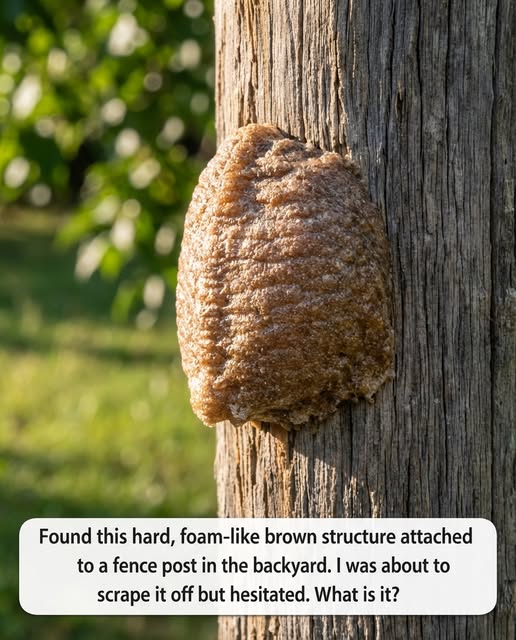
It begins as a subtle anomaly on the landscape of your backyard—a strange, architectural oddity clinging to the rough cedar of a fence post or the slender limb of a dormant rose bush. At first glance, it appears almost mechanical or industrial, like a dollop of hardened spray foam or a dried bit of mud that has been meticulously sculpted. It is hard to the touch, colored in shades of toasted tan or weathered bark, and possesses a ridged, papery texture that feels both fragile and indestructible.
Most homeowners, fueled by the instinct to prune and polish their outdoor spaces, see this as an intrusion. They reach for a scraper or a gloved hand, prepared to flick the “growth” into the grass. But to do so is to unknowingly dismantle one of nature’s most sophisticated survival pods. This brown, foam-like clump is not a fungus, nor is it the debris of a backyard project; it is an ootheca—the masterfully engineered egg case of the praying mantis.
The Architecture of Survival
The story of this mysterious clump began months ago, during the cooling twilight of late summer or early autumn. A female praying mantis, heavy with the next generation, sought out a stable anchor point for her offspring. Once she selected a site—be it a sturdy twig, a stone wall, or the underside of a fence rail—she began a biological manufacturing process that would put modern 3D printers to shame.
Continue reading next page…