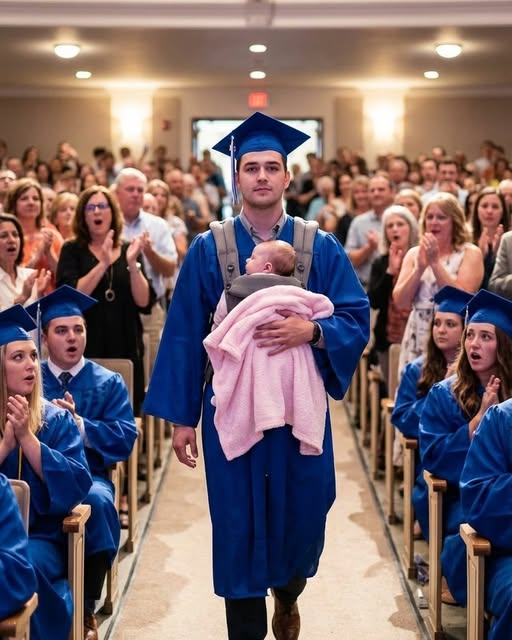
A few nights before graduation, Adrian came to me with something he had been carrying alone. He told me he was going to become a father. The news was heavy, not because of disappointment, but because of fear—his, not mine. He spoke about responsibility, about his girlfriend Hannah, and about a child already born into the world. Most of all, he spoke about choice. About refusing to repeat the pattern of absence that had defined his own childhood.
“I’m not leaving,” he told me quietly.
That promise became the quiet center of everything that followed.
On the day of graduation, the ceremony unfolded like every other—names called, applause rising and falling, speeches about futures waiting to be written. Then Adrian stepped out of line and walked toward me instead of the stage. In his arms was a newborn baby wrapped in soft fabric, a life so new it still seemed to belong more to hope than reality.
The room shifted instantly. Whispers spread faster than the program announcements. Confusion turned into judgment in seconds, the kind of snap decisions people make when they believe they understand a situation they’ve only glimpsed.
But Adrian didn’t stop.
He walked forward anyway.
Holding his daughter carefully, he crossed the stage while the noise behind him grew louder. Some laughed, some questioned, some judged out loud what they clearly hadn’t taken the time to understand. I felt every bit of it—the weight of their assumptions, the sting of old labels resurfacing—but he never flinched.
When he reached the microphone, the room slowly quieted, unsure of what would come next.
What he said wasn’t rehearsed or polished. It was honest.
He spoke about growing up with a mother who stayed when staying was hard. He spoke about fear, about becoming a father earlier than expected, and about the decision he had already made—that no matter how uncertain life felt, he would not disappear from his child’s story.
“I learned what staying looks like,” he said, glancing back at me.
The silence that followed wasn’t empty anymore. It was heavy with recognition. People who had moments earlier been laughing now sat still, confronted with something far more uncomfortable than surprise—understanding.
Then came the shift.
One person stood. Then another. And slowly, the entire room followed until applause filled the space where judgment had been.
After the ceremony, we went together to meet Hannah. There were no speeches waiting there, no dramatic declarations. Just three young people trying to figure out how to build something stable from uncertainty. Over time, that’s exactly what we did.
Life didn’t suddenly become easy. There were still sleepless nights, financial strain, and moments where everything felt overwhelming. But there was also something new—stability built not on perfection, but on commitment.
And in that, something changed in me too.
I stopped seeing my past as something to hide or explain away. I started seeing it as the foundation that had shaped a son capable of choosing responsibility over avoidance, presence over absence.
Because in the end, the story others tried to define for us was never the one we were living.
We were building something quieter. Stronger. Real.
And sometimes, the most powerful kind of legacy isn’t what you leave behind—it’s what you refuse to walk away from.
If this story moved you, share your thoughts below and join the conversation about what it truly means to stay when it matters most.