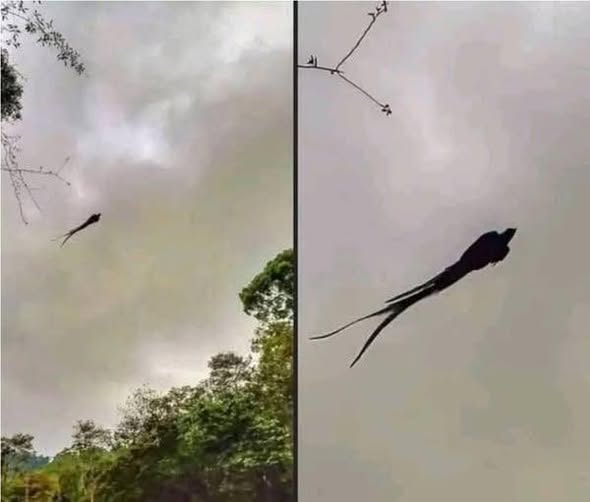
Because of the unusual angle and lighting, many viewers humorously imagined a touch of wizardry leaking into the real world. Some even speculated that the bird was a spectral figure, drifting in search of memories. Notably, just a month earlier, a quetzal had been relocated from Mexico City’s Cuauhtémoc borough to its new home at the Miguel Álvarez del Toro Zoo.
The Quetzal: Nature’s Living Jewel
This monogamous bird makes its home in tropical and subtropical forests, feeding on aguacatillos, insects, mollusks, lizards, and frogs. However, it faces numerous predators—such as emerald toucanets, squirrels, owls, hawks, and eagles. Its greatest threat, unfortunately, remains humans, who capture it for the pet trade, unaware that quetzals cannot survive in captivity. They will stop eating and ultimately perish when caged.
Thankfully, some quetzals have been rescued from captivity and successfully reintroduced into the wild. The bird’s charm lies in its calm, dark eyes, a soft crest atop its head, and a petite yellow beak. Males are especially striking, boasting iridescent plumage with vibrant reds on the belly and shimmering hues of orange, yellow, blue, and emerald green elsewhere. Their long, flowing tail feathers—measuring up to a meter—are a defining feature of the species’ sexual dimorphism.
Females, in contrast, have more subdued green and gray tones and lack the extravagant tail feathers. While the sight of a quetzal in flight is unforgettable, the shrinking cloud forests it depends on are a growing threat to its continued existence.
A Revered Spirit of the Sky
In ancient Mesoamerican civilizations, the quetzal was revered as a sacred bird. Today, although endangered, some individuals can still be observed in the wild. According to Mauricio Ruíz Velasco of UNAM’s Institute of Philological Research, the Mexicas connected the quetzal to the god Quetzalcóatl, while the Mayans linked it to Kukulkán.
These deities were symbols of the sun, the sky, and—fittingly—freedom. The quetzal embodies this freedom quite literally, as it cannot survive in confinement. This inability to live in captivity underscores its spiritual significance and makes the image of a quetzal soaring through the mist-covered forests even more powerful.