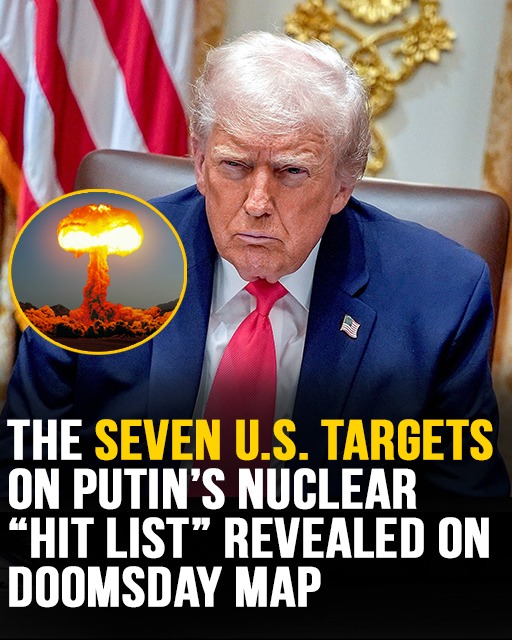
Rising geopolitical tensions have fueled renewed concern after reports referenced a “doomsday map” outlining seven U.S. locations that could theoretically be considered strategic targets in the event of a large-scale nuclear conflict involving Vladimir Putin.
While no official confirmation has verified any active targeting list, the discussion has intensified global anxiety amid escalating military and diplomatic strain between major world powers.
Growing Tensions Between Nuclear Powers
Relations between Russia and Western nations have remained strained since the start of the Ukraine conflict. U.S. support for Ukraine was initially authorized under Joe Biden, prompting strong criticism from Moscow.
Kremlin spokesperson Dmitry Peskov previously described U.S. involvement as “reckless” and warned that Western military assistance represents what Russia views as deeper participation in the conflict. Russian officials have repeatedly cautioned that NATO expansion and weapons transfers increase the risk of broader confrontation.
Meanwhile, Donald Trump has taken a more aggressive posture in other regions, further complicating global dynamics.
Middle East Escalation Adds Pressure
On June 21, President Trump confirmed U.S. airstrikes on three Iranian nuclear facilities, including Fordow, Natanz, and Esfahan. According to public statements, the sites were targeted in an effort to disrupt nuclear enrichment operations.
Shortly afterward, Iran responded with a missile strike on Al-Udeid Air Base, the largest U.S. military base in the Middle East. Iran’s Islamic Revolutionary Guard Corps stated that attacks on its sovereignty would not go unanswered.
These developments have contributed to heightened defense readiness, military deployments, and broader concerns about energy markets, global security, and geopolitical risk.
State of the Union Warning on Missile Threats
During his recent State of the Union address, President Trump warned that Iran is advancing missile capabilities that could potentially threaten Europe and U.S. assets abroad. He emphasized that while diplomacy remains preferable, the United States would not allow Iran to obtain a nuclear weapon.
The speech further underscored how interconnected global flashpoints — including Eastern Europe and the Middle East — are influencing defense policy, national security planning, and military strategy.
Reported U.S. Locations Mentioned in Broadcast
According to media reports citing a now-deleted Russian state TV segment, several American sites were discussed as potential strategic targets in a hypothetical war scenario. While no official documentation confirms these as active targets, the locations mentioned reportedly included:
- The Pentagon – Headquarters of the U.S. Department of Defense
- Camp David – The presidential retreat in Maryland
- Jim Creek Naval Radio Station – A communications site supporting U.S. submarine operations
- Fort Ritchie – A former military installation with historical strategic use
- McClellan Air Force Base – A decommissioned base in California
- Kirtland Air Force Base – Associated with nuclear weapons research and storage
- Pantex Plant – A key nuclear weapons assembly and disassembly facility
Defense analysts note that strategic military infrastructure and nuclear command facilities are commonly referenced in theoretical war-gaming discussions. However, no verified intelligence confirms an official “hit list.”
Diplomatic Withdrawals and Heightened Readiness
Amid the broader instability, the U.S. government has ordered certain diplomatic staff to depart from high-risk areas, including Beirut, and has adjusted personnel levels at bases in Syria and Qatar.
Although Russia has not directly entered military conflict with the United States, its strategic alignment with Iran and continued involvement in Ukraine have added complexity to global security calculations.
Ukrainian President Volodymyr Zelenskyy has warned that the conflict risks expanding further, describing the situation as increasingly dangerous if escalation is not contained.
Global Security and Nuclear Risk Concerns
Security experts frequently stress that nuclear deterrence strategies are built on prevention rather than action. While hypothetical targeting discussions often surface during periods of geopolitical strain, diplomatic channels and international agreements remain central to avoiding direct confrontation.
As tensions continue across multiple regions, global markets, defense policy analysts, and national security experts are closely monitoring developments.
The evolving situation underscores the importance of diplomatic engagement, strategic stability, and international cooperation in reducing nuclear risk.