What Had Actually Happened
The station did not take us to a holding area.
It took us to a private briefing room, where Mr. Wallace sat looking drained and shaken, alongside an elderly woman in a wheelchair who was holding a small fabric-wrapped bundle in her lap with both hands, the way you hold something irreplaceable.
The story they told us made the room go completely quiet.
After Dilan had spent his entire savings on new sneakers for Mr. Wallace — refusing every attempt his teacher made to decline — the two of them had been walking home through a shortcut behind the shopping center when three men ambushed them. The men weren’t interested in the shoes. They went for Mr. Wallace’s old leather briefcase.
“I tried to let it go,” Mr. Wallace said, his voice breaking in a way that a room full of adults responded to in kind. “But Dilan didn’t. He put himself between those men and the bag and he would not let go. Not when they tried to pull him off. Not when they tore his jacket. He held on until a patrol car came around the corner and they ran.”
I looked at my son. He was staring at the floor.
“Dilan,” I said. “Why would you risk your physical safety for a briefcase?”
The elderly woman in the wheelchair began to unwrap the fabric bundle in her lap. Inside was a small, ornate ceramic urn.
Mr. Wallace’s voice dropped to almost nothing.
“My daughter’s ashes,” he said. “I was bringing her to my mother so we could bury her this weekend. Next to her grandmother.” He paused. “If Dilan had let go of that bag, the only physical piece of my child I have left in the world would be gone. He didn’t save a briefcase, Paula. He saved the only thing I have left of her.”
The silence that followed was the kind that a room full of people create together when words stop being adequate.
Dilan looked up from the floor. His face was red. “I didn’t know what was inside,” he said quietly. “I just knew it belonged to you. And they didn’t have the right to take it.”
The Bicycle — and the Shoes Mr. Wallace Was Still Wearing
The sheriff cleared his throat. The professional composure was still intact, but only just.
“We couldn’t explain over the phone,” he said. “We were still processing the scene and needed to confirm Dilan wasn’t being followed home. He conducted himself, ma’am, with more courage than most adults I’ve worked with.”
When we walked out to the parking lot, a bicycle was leaning against a lamppost.
It was brand new. Deep blue frame, chrome accents, thick mountain tires — far better than anything Dilan had been looking at in the used listings he’d bookmarked on my laptop. Mr. Wallace told us the officers had collected contributions and gone in together. A boy who emptied his savings jar for someone else’s dignity, he said, should never have to walk.
Dilan reached out and touched the handlebars with both hands. Then he looked down at Mr. Wallace’s feet.
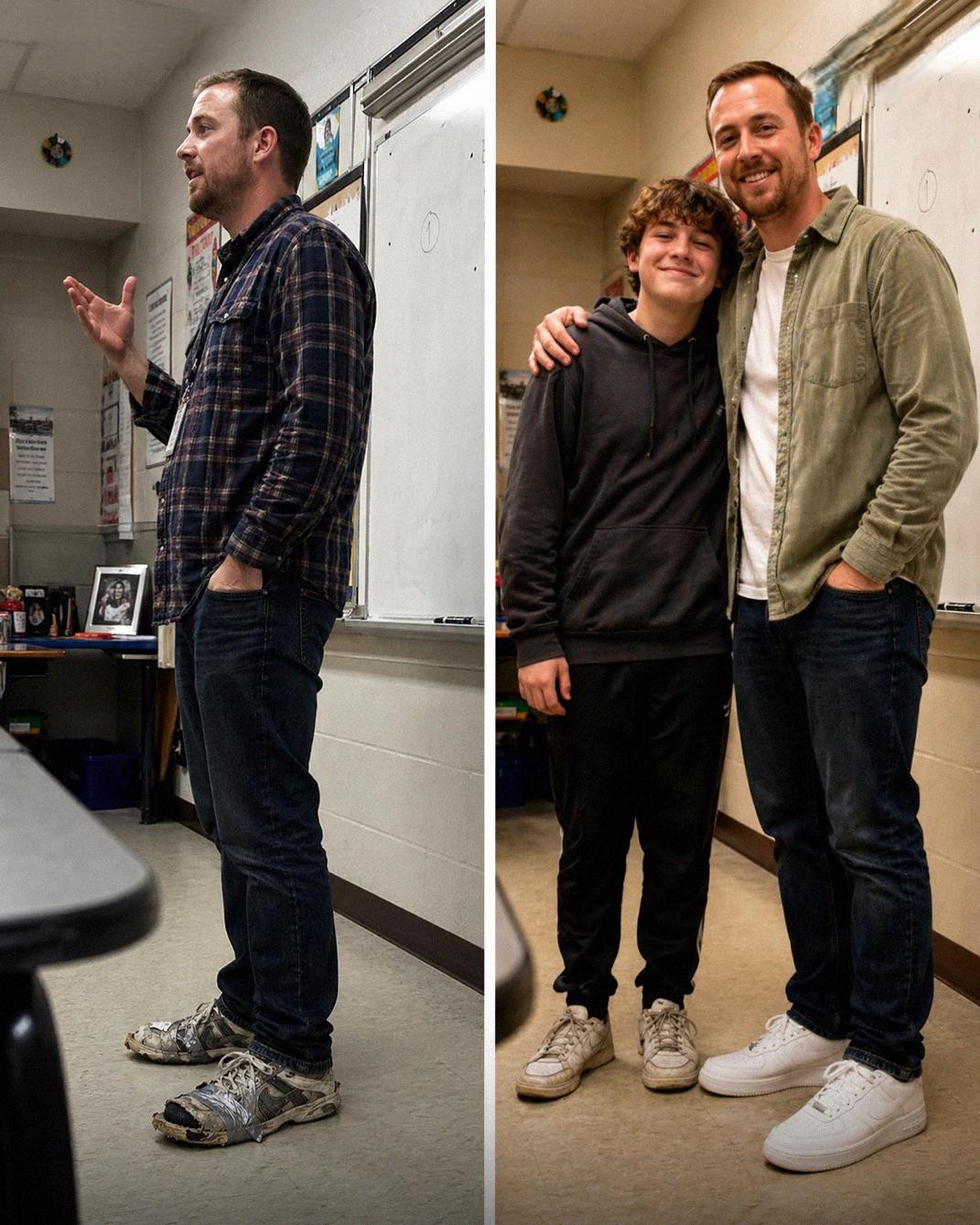
The teacher was still wearing the old pair. The ones with holes in the soles. The ones the other kids had laughed at.
“Why aren’t you wearing the new ones?” Dilan asked.
Mr. Wallace looked down at the worn shoes with an expression I will never fully be able to describe — grief and love occupying the same space simultaneously, the way they do when something is both a wound and a treasure.
“My daughter picked these out for me years ago,” he said. “She told me they made me look cool.” A pause. “I’ll wear the new ones tomorrow. I promise. But today I needed to feel her close to me one more time.”
What That Day Left Behind
We drove home — Dilan on his new bicycle, me following slowly in the car — and I found myself glancing at the empty passenger seat with the specific awareness that grief brings of the people who should be present for the moments that matter most.
Simon would have known exactly what to say. He always did.
What I knew, watching my son navigate the sidewalk ahead of me on a bicycle he had earned three times over in ways that had nothing to do with money, was that the long chapter of simply surviving had quietly given way to something else. Not comfort, not ease — those are still works in progress. But something more foundational.
Dilan had learned, at fourteen, that there is a category of things in this world that money cannot protect. That courage and loyalty and the refusal to let go of what matters — even when letting go would be easier, even when holding on costs you everything you’ve been working toward — are the only currencies that can.
The jar on the shelf is empty. It will fill up again. That is not the part of this story I think about when I look at it.
I think about a boy with blistered hands and a quiet heart who decided, without announcement or expectation of recognition, that someone else’s dignity was worth more than his own dream.
And I think that wherever Simon is, he already knows.