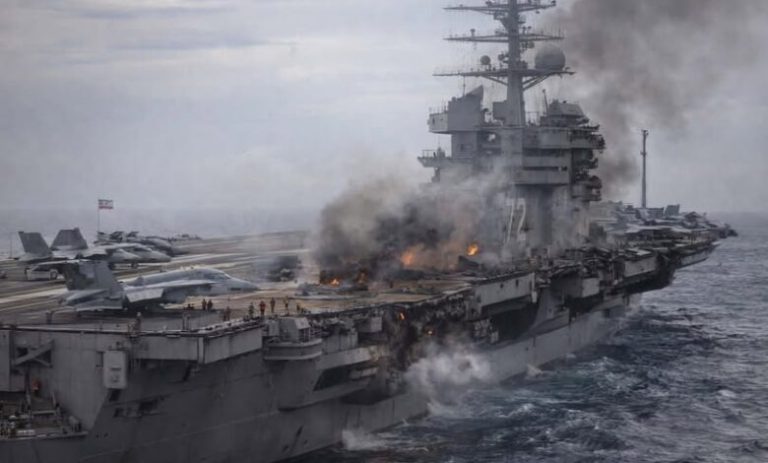
CENTCOM and the Pentagon moved quickly to counter Iranian claims. Defense officials confirmed that while missiles were launched toward U.S. assets in the Gulf, the Lincoln’s defenses intercepted them, or they fell harmlessly into the water. Official imagery and data show the carrier fully operational, continuing air operations in Operation Epic Fury, the ongoing campaign to neutralize Iranian missile capabilities.
The Context: Epic Fury and Iranian Leadership Loss
The tension surrounding the Lincoln cannot be separated from the strikes of February 28. U.S.-Israeli air campaigns targeted roughly 2,000 sites, including nuclear infrastructure and command centers. Iranian media later confirmed that Supreme Leader Ayatollah Ali Khamenei was killed during the attacks, triggering national mourning and a chaotic wave of retaliatory measures.
The Conflict Expands
While the Lincoln reportedly avoided damage, the region has not:
Regional Strikes: Iran fired drones and missiles at U.S. bases across the UAE, Qatar, Kuwait, Bahrain, and Saudi Arabia.
Naval Losses: CENTCOM confirmed sinking an Iranian Jamaran-class corvette at Chah Bahar pier.
Second Front: Heavy rocket fire erupted between Israel and Hezbollah, ending a ceasefire in effect since 2024.
American Casualties: Three U.S. service members have died, with five seriously injured in the opening phases of the conflict.
Global Impact
Even the unverified claim of a carrier strike rattled global markets. Oil prices spiked 10% in one day, with concerns over the Strait of Hormuz creating volatility unseen in years. Internet blackouts in Iran have cut connectivity to just 1%, leaving millions in uncertainty, while airport closures in Dubai, Abu Dhabi, and Doha disrupt travel across the region.
Why the Lincoln Matters
The USS Abraham Lincoln is the flagship of Carrier Strike Group Three. Its survival is crucial for maintaining U.S. air superiority and protecting commercial shipping through the Arabian Sea. Beyond military strategy, the debate over whether the carrier was hit has political weight: Tehran uses the claim to rally domestic support, while Washington’s denial reassures Gulf allies relying on American protection.
A Powder Keg Situation
As of March 2, Hezbollah has entered the conflict, and Iranian-backed militias in Iraq are launching drones at U.S. positions. The Gulf remains a tinderbox, and the Lincoln, along with its escort ships, faces mounting pressure. This confrontation may redefine security calculations in the Middle East for years to come.
The USS Abraham Lincoln is more than a naval vessel—it has become a symbol of power projection, a focus of global attention, and a centerpiece in a crisis with potentially historic consequences. Analysts and officials continue to monitor developments closely, balancing verification with rapidly unfolding events.
The Gulf crisis is evolving fast. What do you think the next move will be for global powers? Share your thoughts and stay updated in the comments below.