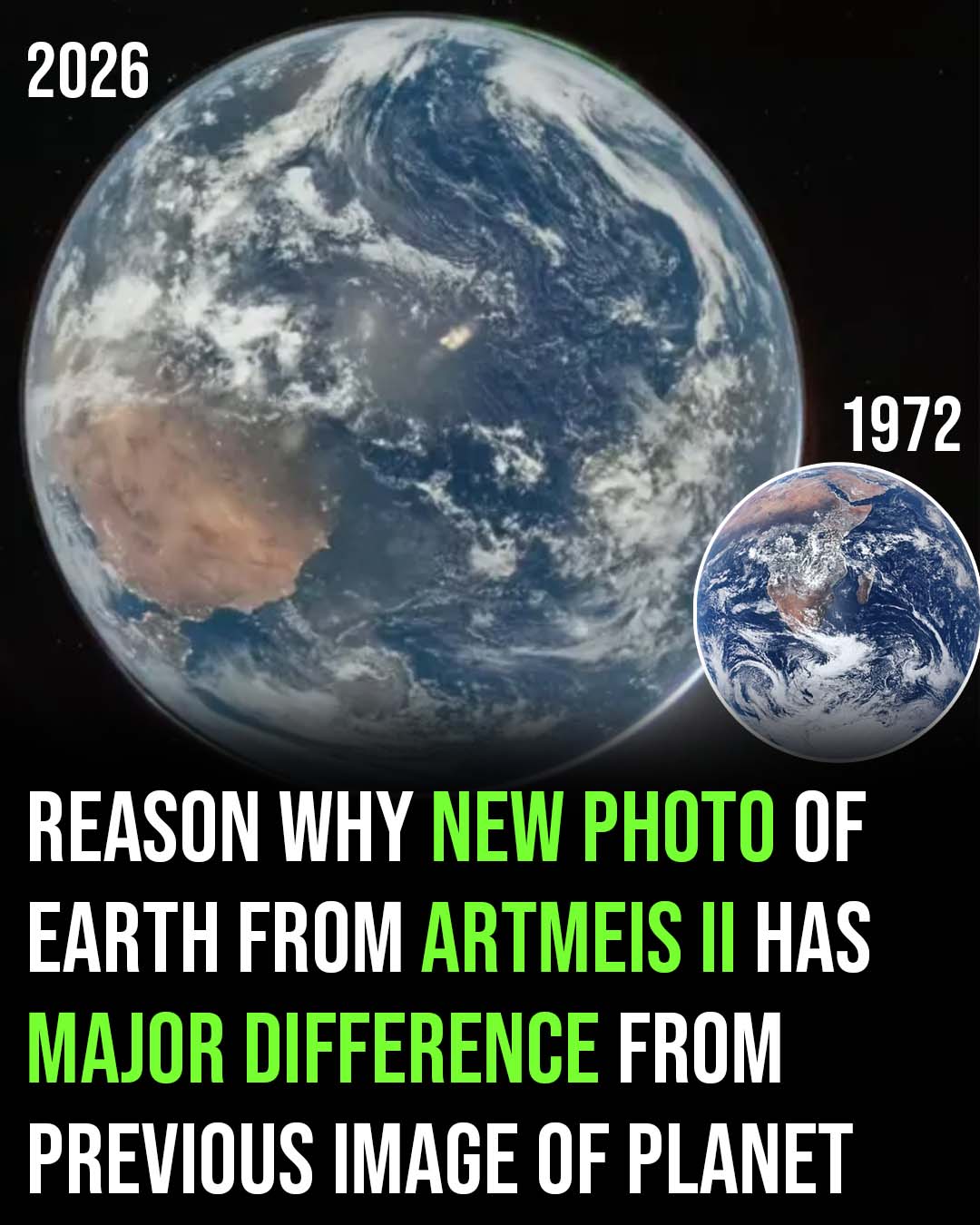
A recently released image of Earth captured during space exploration efforts by NASA’s Artemis II mission has quickly gained attention online. Many viewers noticed that it looks noticeably different from the iconic photograph taken during the 1972 Apollo mission, sparking widespread discussion.
On April 1, 2026, astronauts Reid Wiseman, Victor Glover, Christina Koch, and Jeremy Hansen launched aboard the Orion spacecraft as part of Artemis II. This marks the first crewed journey toward lunar space in more than 50 years, following the legacy of Apollo 17.
During the 10-day mission, the crew is testing advanced space technology designed to support future Moon landings and eventual human missions to Mars—key goals in modern aerospace innovation.
A New Perspective of Earth From Deep Space
As the spacecraft traveled toward the Moon after its translunar injection burn, the astronauts captured stunning views of Earth from deep space. Mission commander Reid Wiseman used a Nikon D5 camera to photograph the planet through one of Orion’s windows, producing high-resolution images that quickly circulated across social media platforms.
One image, showing Wiseman alongside a curved view of Earth, was captioned simply: “There are no words.” Another photo highlighted Earth’s vibrant colors and cloud formations set against the dark backdrop of space.
NASA later shared a side-by-side comparison of the 2026 image with the famous 1972 Apollo photograph. The post emphasized how far space science and technology have advanced, while also noting that Earth remains visually striking from orbit.
Online Reactions and Environmental Speculation
The comparison quickly led to discussions across the internet. Some users speculated that environmental factors such as climate change or pollution could explain why the newer image appeared different.
Comments ranged from concern about Earth’s condition to observations that the planet looked less vibrant than in the earlier image. This reflects ongoing global interest in environmental awareness and sustainability.
The Real Explanation: Lighting and Camera Technology
However, many experts and informed users pointed out that the difference is most likely due to photography conditions rather than changes to Earth itself.
One key factor is lighting. The newer image captures a portion of Earth that is not directly facing the sun, meaning it shows the planet’s night side. This naturally results in a darker appearance.
Another important detail is camera settings. The Nikon D5 used by Wiseman was set to a very high ISO level (51200), which increases the sensor’s sensitivity to light. While this allows images to be captured in low-light conditions, it can also create a grainier or more washed-out effect compared to older images taken under different conditions.
In contrast, the 1972 Apollo image was taken with different equipment, lighting, and exposure settings—making direct visual comparisons less straightforward.
A Powerful Reminder About Our Planet
Beyond the technical discussion, the image serves as a meaningful reminder of Earth’s uniqueness. From space, national borders disappear, and the planet appears as a single, shared home.
According to NASA imagery specialists, images like these highlight the importance of global unity and reinforce the idea that everyone shares responsibility for protecting the planet.
Final Takeaway
While the Artemis II Earth image may look different from the 1972 version, the variation is largely due to lighting angles and camera technology—not a visible decline in the planet itself.
At its core, the photo continues to inspire awe and underscores the importance of scientific discovery, space missions, and ongoing efforts to understand and protect Earth.