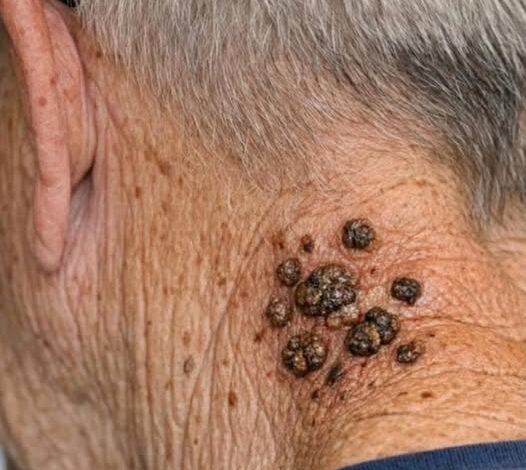
As we age, our skin naturally changes. Fine lines deepen, sun spots appear, and small raised growths can develop on the neck, chest, or back. To family members, especially grandchildren, a dark, waxy bump on a grandparent’s neck can feel alarming — even like a warning sign of something serious.
In most cases, however, these growths are harmless and incredibly common. They’re known as seborrheic keratoses — benign (non-cancerous) skin growths that typically appear after age 50.
What Is Seborrheic Keratosis?
Seborrheic keratosis is one of the most common non-cancerous skin conditions seen in older adults. Dermatologists often describe these spots as looking “stuck on” the skin — similar to a drop of candle wax or a small raised patch.
They can vary in:
- Color (light tan to dark brown or black)
- Texture (smooth, velvety, rough, or slightly crumbly)
- Size (from tiny specks to larger raised patches)
Despite their appearance, these growths are not skin cancer and do not turn into melanoma. They form from an overgrowth of keratinocytes — the primary cells in the outer layer of skin.
Why Do They Appear?
While the exact cause isn’t fully understood, several factors are associated with seborrheic keratosis:
- Aging: Most common after 50
- Genetics: Often runs in families
- Sun exposure: May contribute in some cases
Unlike moles, these spots do not grow deep roots and do not spread through the body.
Why They Can Look Concerning
Even though they’re harmless, seborrheic keratoses can cause anxiety because:
- They may appear suddenly
- They can grow relatively quickly
- Darker ones may resemble melanoma
It’s natural for family members to worry when they notice a new or unusual spot on a loved one’s skin. However, dermatologists can usually identify seborrheic keratosis quickly through a simple visual exam.
In some cases, a dermatoscope (a handheld magnifying device with light) is used to examine the structure more closely. If there is ever uncertainty, a biopsy can confirm the diagnosis.
When to See a Doctor
While most seborrheic keratoses are harmless, it’s important to monitor skin changes. A medical professional should evaluate a growth if it:
- Changes rapidly in size
- Has irregular borders
- Contains multiple colors
- Bleeds without injury
- Looks noticeably different from other spots
Dermatologists often refer to this as the “Ugly Duckling” sign — if one spot looks very different from the rest, it deserves attention.
Can They Be Removed?
Although removal isn’t medically necessary in most cases, some people choose treatment if the growth:
- Gets irritated by clothing or jewelry
- Itches or becomes inflamed
- Bleeds after being snagged
- Causes cosmetic concerns
Common in-office procedures include:
- Cryotherapy: Freezing the spot with liquid nitrogen
- Shave excision: Gently removing the raised growth
- Curettage: Carefully scraping the area
These outpatient procedures are generally quick and leave minimal scarring.
A Reminder About Skin Health
In today’s digital age, it’s easy to turn to online searches and assume the worst. But not every dark or raised skin spot signals skin cancer.
Encouraging older family members to schedule routine skin exams is a proactive way to support long-term health and peace of mind. Early detection is essential for true skin cancer prevention — but so is avoiding unnecessary anxiety.
The Bottom Line
Seborrheic keratoses are extremely common, especially in older adults. While they may look unusual, they are typically harmless signs of aging skin.
Rather than viewing them as a “silent warning,” it’s helpful to see them for what they usually are: benign skin growths that reflect the natural passage of time.
When in doubt, a quick visit to a board-certified dermatologist can provide reassurance — and protect overall skin health for years to come.